
Most new track operators size their fleet by walking a trade show, looking at a competitor’s pit lane and guessing. Then the first busy Saturday arrives, the queue runs past the pit exit, and the fix costs more than the original order would have.
Fleet size is arithmetic, not taste. Four numbers decide it, and you can produce all four on one sheet of paper before you place a deposit.
How many go-karts? Start with four numbers
Every fleet calculation reduces to the same four inputs. Get them wrong and the answer is wrong no matter how good the kart is.
- Session length. How long a customer actually drives. Six to ten minutes is the commercial norm; eight is the most common compromise between perceived value and throughput.
- Turnaround. Time from one group stopping to the next group leaving the pit. Belt, briefing check, seat adjustment, restart. Two to four minutes in a well-run venue; five or more if you are still finding your rhythm.
- Peak hourly demand. Not average weekend traffic. The two hours on Saturday afternoon that decide whether people come back.
- Service buffer. The percentage of the fleet that is charging, being repaired or waiting for a part at any given moment.
Notice what is not on the list: track length, engine size, or how many karts the manufacturer wants to sell you. Those come after the arithmetic.
Worked example: 12 karts, 8-minute sessions
Take a track that can physically hold twelve karts. Sessions run eight minutes with a three-minute turnaround.
That is eleven minutes per cycle. Sixty divided by eleven is 5.45, so in practice you complete five full cycles an hour — the sixth never quite closes before the hour turns.
Twelve karts times five cycles equals sixty rides an hour at perfect utilisation. No venue runs at a hundred percent: briefings overrun, a customer needs help with a harness, someone stalls at the pit exit. At a realistic 85 percent, you are selling 51 rides an hour.
Now compare that to demand. If your Saturday peak is 120 riders across two hours, you need about 60 rides an hour. Your twelve karts deliver 51. You are short by roughly two karts before you have accounted for a single breakdown — which is exactly the gap that turns into a forty-minute queue and a one-star review.
The spare ratio nobody budgets for
Every operating fleet needs a buffer. For commercial karting, plan on 10 to 15 percent of the running fleet as spares. A twelve-kart track should own thirteen or fourteen.
The reason is not pessimism, it is the shape of the day. Karts do not fail evenly. They fail at 2pm on Saturday, in the middle of your peak, when a replacement cannot be sourced and the queue is already outside.
Charging is the same problem wearing a different hat. A lead-acid or standard lithium pack charged from empty takes three to four hours. If a kart comes in at 40 percent and you plug it in, it is out of service for the rest of the afternoon. On an eight-hour operating day that quietly removes a fifth of your fleet.
This is why quick-swap battery architecture changes fleet maths rather than just convenience. A kart with a swappable pack is out of service for the length of the swap, not the length of the charge. One spare pack per two or three karts keeps the whole fleet earning through a full day, and it removes the afternoon cliff where half your capacity disappears at once.
Six, eight or ten-minute sessions: what changes
Session length is the single most powerful lever on revenue per hour, and it is usually set by habit rather than calculation. The table below uses a 12-kart track with a three-minute turnaround.
| Session | Cycle time | Cycles per hour | Rides/hour (gross) | Rides/hour at 85% |
|---|---|---|---|---|
| 6 minutes | 9 min | 6 | 72 | 61 |
| 8 minutes | 11 min | 5 | 60 | 51 |
| 10 minutes | 13 min | 4 | 48 | 41 |
Cutting from ten minutes to eight buys you 25 percent more capacity from the same hardware. Cutting to six buys 49 percent. But shorter sessions reduce perceived value, and on a drift track the first two minutes are spent learning the kart — a six-minute run can feel like a taste rather than an experience.
The practical answer for most venues is to run two session lengths: a shorter session at peak, when demand exceeds capacity, and a longer one in the quiet hours, when the marginal customer is worth more than the marginal throughput. Operators who price purely per session rather than per minute usually leave money on the table in both directions.
Three mistakes that cost real money
Buying to average, not to peak. Average weekday traffic is a comfortable number to plan around and a terrible one to build around. Fleets are sized by the busiest two hours of the busiest day, then depreciated over seven days a week.
Counting karts instead of seats. A twelve-kart track with single-seaters moves twelve people per cycle. The same footprint with two-seaters moves twenty-four — but two-seaters need a wider turning circle, a different barrier layout and a different insurance conversation. Decide which business you are in before you specify the fleet.
Budgeting the purchase and ignoring the consumables. Tyres, brake pads, belts, controllers and batteries are the operating cost that decides whether the venue is profitable in year three. Any kart design that removes a consumable — physical drift geometry instead of replaceable drift rings, for example — changes the annual cost line more than a discount on the purchase price ever will. The commercial go-kart buying guide breaks down which specifications actually drive that cost.
What this means for the kart you buy
If the calculation above produces a fleet of twelve with two spares, the specification question becomes narrow: can this kart do five consecutive commercial sessions without a mechanic, and can it be returned to service in under five minutes?
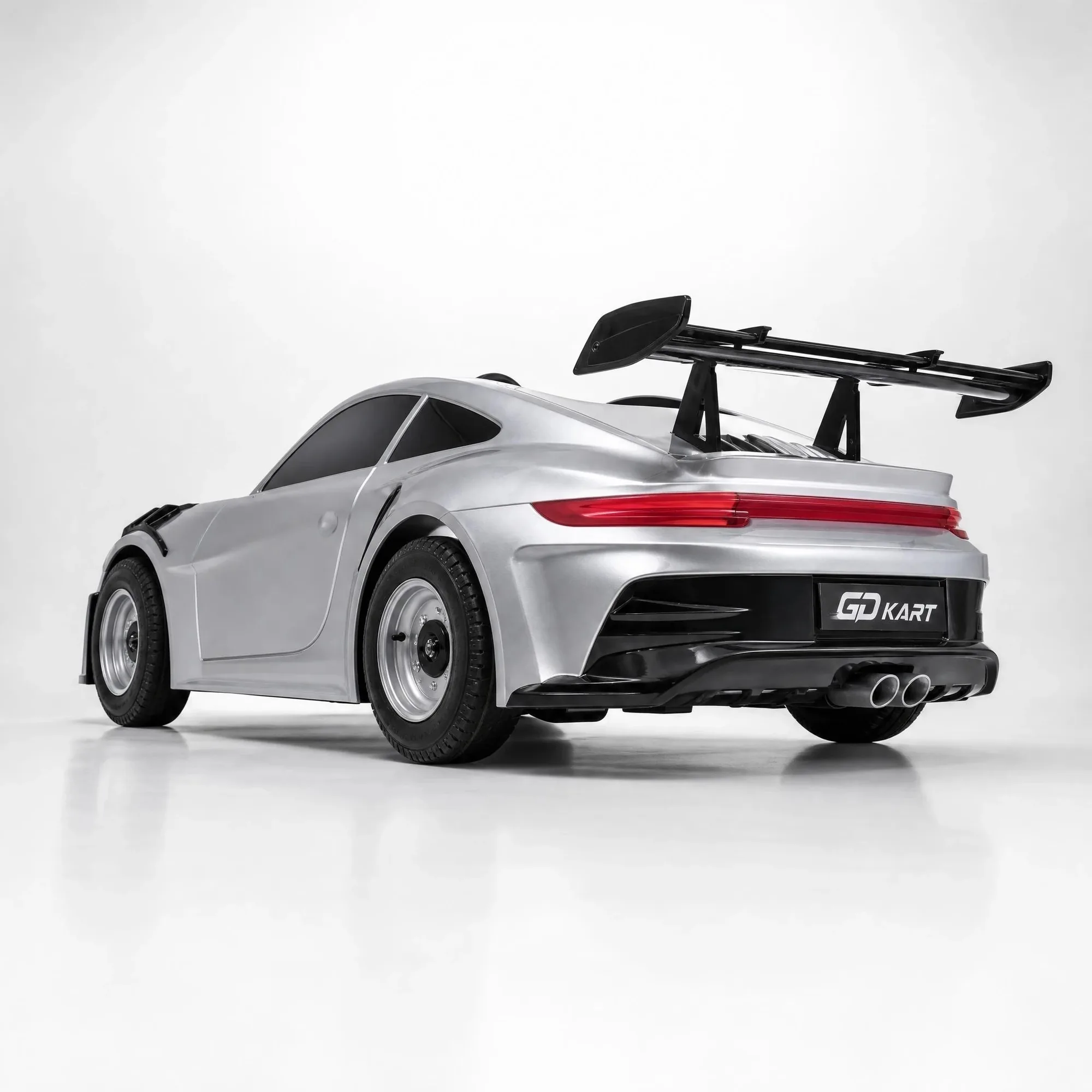
That is the design brief behind our 1:2 scale electric drift models. The P964 Cabrio runs a 72 V 40 Ah quick-swap pack with roughly 40 minutes of continuous drifting per pack, so a spare battery — not a spare kart — covers the afternoon peak. The Hellcat 1:2 uses the same 2500 W mid-mount powertrain with a more aggressive drift setup for venues where drifting is the attraction rather than a side effect.

Both are built on physical drift geometry with no drift rings to replace, which removes one recurring cost and one maintenance window from the weekly schedule. If you are comparing the full range, the eight-model line-up covers electric drift, petrol race and off-road in the same serviceable architecture.
FAQ
How many go-karts do I need for a small indoor track?
A ten-kart track running eight-minute sessions with a three-minute turnaround delivers around 42 paid rides an hour. If your peak demand is 50 riders an hour, you need either two more karts or a shorter session. Size to peak, then add 10 to 15 percent as spares.
Is it better to buy extra karts or a spare battery?
For electric fleets, a spare battery is usually the cheaper capacity. One extra pack per two or three karts keeps the whole fleet running through a charge cycle, while an extra kart adds purchase cost, storage space and another unit to maintain.
How long does a session need to be to feel worth the money?
On a drift track, most customers feel the experience starts around minute three, once they have found the throttle and the steering balance. Eight minutes is the practical floor for a paid session; ten is more comfortable for first-timers but costs you a fifth of your hourly capacity.
Do I need to account for CE marking when sizing a fleet?
If you are importing into the EU, machinery must meet the Machinery Directive 2006/42/EC, and the documentation package travels with the equipment. In the UK, operators also work to HSE guidance for fairgrounds and amusement parks. Neither changes the arithmetic, but both change the lead time.
Where can I find industry benchmarks for attraction operators?
The family entertainment centre community at IAAPA publishes operator-facing material on attendance, staffing and capital planning that is a reasonable starting point for demand assumptions.
Send us your track layout, session length and peak weekend numbers, and we will come back with a fleet size, a configuration and a delivery plan. Start with the quote request, or read how we support track design and fleet planning from the first layout sketch.