
Most rental fleet problems start on the day a kart is accepted, not the day it breaks. A commercial go-kart inspection done properly takes about forty minutes per unit, and it is the cheapest line item in the whole purchase. Skip it and every defect becomes yours, usually after the busiest Saturday of the month.
The checks below are the ones that separate a kart that survives three seasons from one that spends them in the workshop. They are written for the buyer standing in a dispatch bay or opening a container, not for a mechanic with a lift and a service manual. A commercial go-kart inspection done once, properly, costs less than the first month of warranty arguments.
What a Commercial Go-Kart Inspection Should Catch
An inspection is not a test drive. Ninety seconds on smooth concrete tells you the kart feels fine. It does not tell you what will fail in month eight, when the shell is scuffed and the unit is running two hundred sessions a week.
Three failure families cover most of the money: structure, drivetrain and energy. Structure means frame rails, welds and mounting points. Drivetrain means axle, hubs, bearings and brakes. Energy means pack, loom, controller and connectors. Paint, decals and seat covers are cosmetic and negotiable.
Work in that order. Regulators think the same way: the UK Health and Safety Executive treats documented inspection and maintenance as part of operating fairgrounds and amusement rides safely, not as paperwork to complete after the season ends. Your pre-delivery check is the first entry in that record.
Start With the Frame, Not the Paint
A fresh coat of paint hides more than it fixes. Ask for the kart on a clean floor with the bodywork off, or at minimum with the seat out so you can see the spine of the chassis. A commercial go-kart inspection starts here, with the panels leaning against the wall, not with a walk around a finished shell.
Check every weld junction where steering loads arrive: the column mount, the front stub axle brackets and the rear bearing carriers. A crack in any of them is structural, not cosmetic. Run a straight edge along the main rails and look for a rail that has been pulled straight after an impact. The paint will be thicker there and the weld beads will sit unevenly.
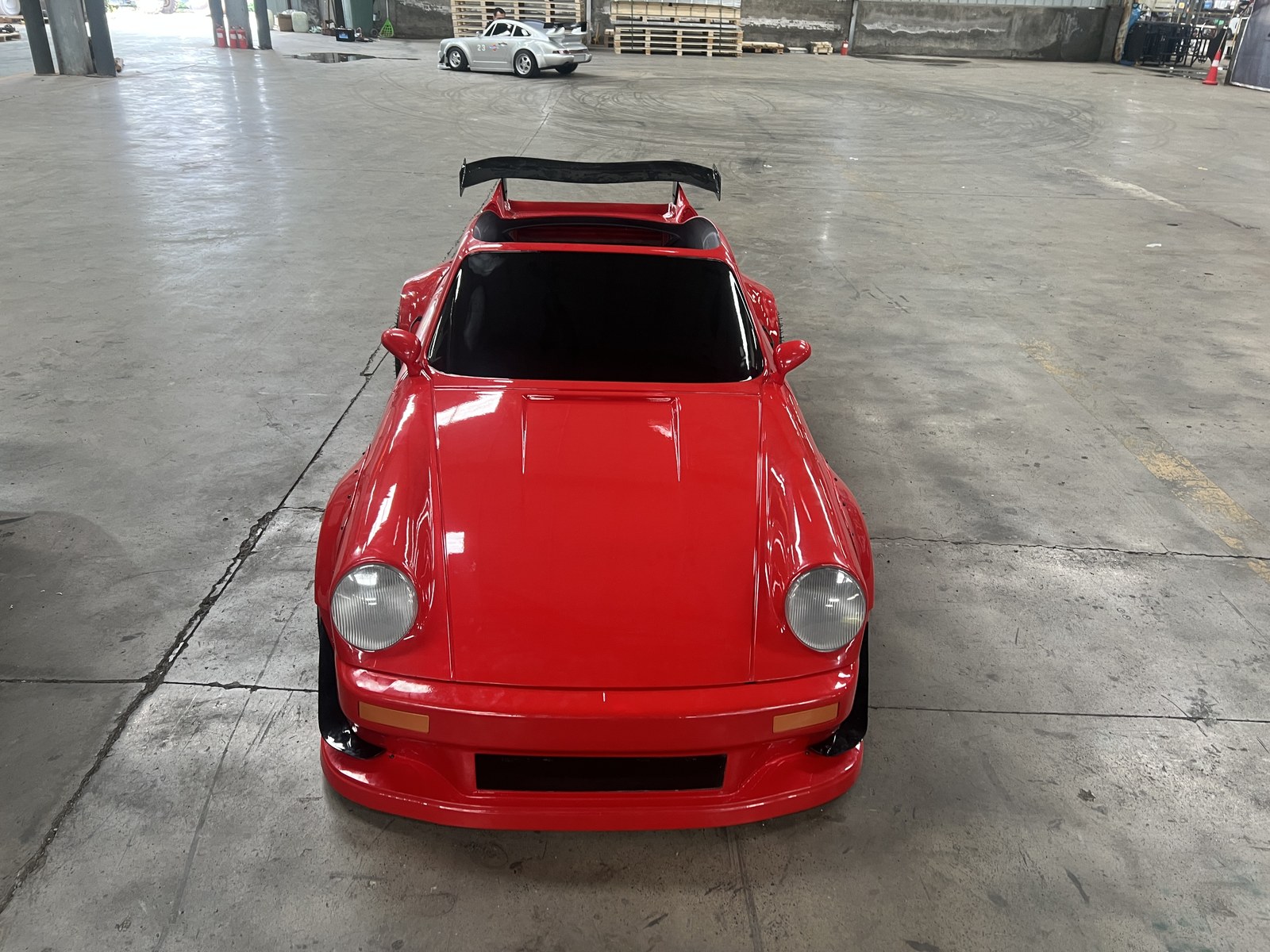
On a 964-style or GT3-style shell, remember that the composite body is a cover over a steel chassis. The cover can look immaculate while the frame underneath has been straightened. Panels off, or no deal. If the units are bound for the EU, the machine also needs the documentation that goes with CE marking under the Machinery Directive, and the European Commission machinery pages list what that file should contain. Ask for it before the container is loaded.
Axles, Hubs and Brakes
Put the kart on stands and spin each wheel by hand. This is the stage of a commercial go-kart inspection that finds money. A rear axle should turn with a faint drag from the brake and nothing else. Any rumble, any notch, or a wheel that keeps spinning after you stop pushing means a bearing or a warped disc.
Grab each wheel at twelve and six o’clock and push-pull. Movement is hub or bearing play, and it only grows. On a solid rear axle, confirm that both wheels sit at the same offset and that the axle nuts are pinned rather than just tightened.
Brakes are the check most buyers rush. Look at pad thickness, disc scoring and pedal travel, then hold firm pressure for thirty seconds. A pedal that sinks is a hydraulic fault, and a rental kart with a soft brake is a liability claim waiting to happen.
For family venues, judge brake feel too: light pedal effort matters more than ultimate stopping force when most drivers are first-timers.
Motor, Controller and Pack
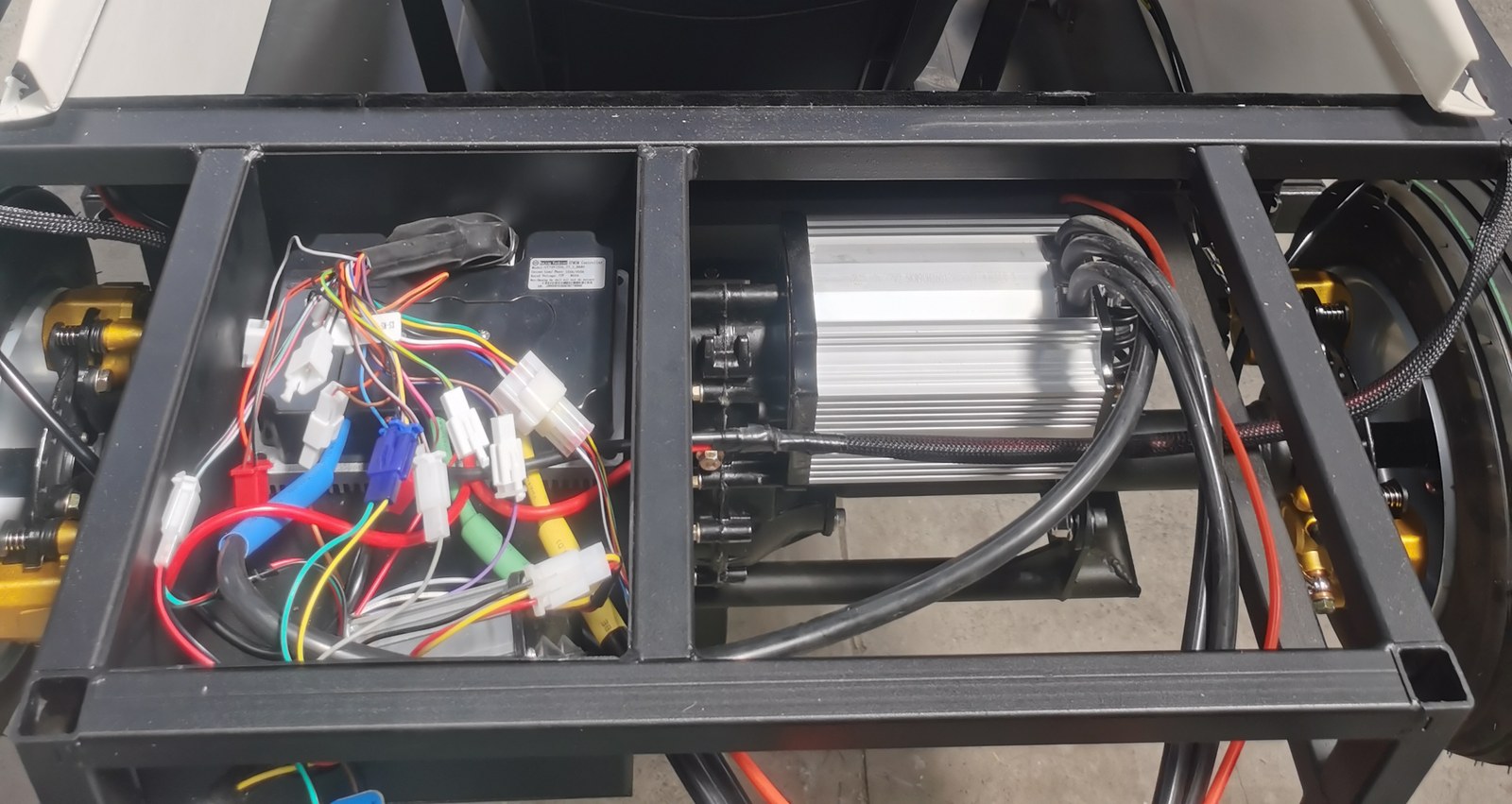
Electric karts rarely fail at the motor, which is why this stage of a commercial go-kart inspection concentrates on the wiring around it. They fail at connectors, and they fail at the pack. Open the motor bay and look for a loom that has been rubbing on a frame edge, unsealed plugs sitting where water pools, and terminals with corrosion already starting.
The 964-style and wide-body models run a 2500 W mid-mounted motor on a 72 V 50 Ah pack, rated at 80 km/h (50 mph), roughly 60 km (37 mi) of range and a 300 kg (661 lb) load. Those figures only hold if the hardware behind them is intact, so verify motor mount bolts, controller heat-sink clearance and pack tie-downs instead of trusting the label on the body.
Ask for the pack build date. A lithium pack that has sat at full charge in a warehouse for six months arrives with capacity already spent, and no inspection sheet will show it. Check the charger against the pack voltage and confirm the connector is keyed so a rider cannot plug it in backwards.
Measure What the Spec Sheet Skips
A commercial go-kart inspection is mostly measurement, so bring a tape measure, a scale and a stopwatch. Spec sheets describe the ideal unit; the one in front of you has to fit your building.
Measure overall width and wheelbase against your narrowest aisle and your tightest corner. A wide-body shell that looks spectacular on a poster can be a nightmare in a 3 m (10 ft) corridor, and barrier damage is a weekly cost, not a one-off. The 964-style convertible and its wide-body sibling share a footprint family, so measure one and you have measured the fleet.
Weigh the kart. The GT3-style ships at 220 kg (485 lb) curb, and the closed and wide-body units are heavier again, which changes floor loading and how many staff it takes to recover a stopped kart. Check the load rating against real riders: 300 kg (661 lb) covers two adults, not two adults and a child.
Time the kart from standstill to its top speed on your longest straight, using a GPS app rather than the dash display. If a unit rated at 80 km/h (50 mph) cannot pull its number on a 60 m straight, that is a setup question you want answered before delivery, not after.
Fit and Reach: Seats, Pedals and Steering
Your average rider is not the person who signed the purchase order. Sit in the kart in the shoes a customer would wear, then put a child in it. A commercial go-kart inspection that skips the driver is only half finished.
Check that the pedal reaches the ball of the foot at full extension, that the steering wheel sits at chest height rather than in the lap, and that the seat back holds the shoulders. If the wheel is too far forward, the driver steers with locked elbows and loses feel within a lap.
Look at the footwell for sharp edges and at the harness anchors for backing plates rather than bolts through thin sheet. On a two-seat unit, the passenger needs a handhold within reach, or they will brace against the driver through every corner.
Seat brackets and pedal positions are the parts most worth changing before a fleet ships. Customisation at order time is cheaper than a retrofit, and a kart that fits a 1.55 m (5 ft 1 in) teenager as well as a 1.85 m (6 ft 1 in) adult earns more per square meter of track.

The 11-Point Checklist
Print this, one sheet per unit, and sign it. A checklist that lives on a phone gets skipped by the third kart of the morning, so keep a printed commercial go-kart inspection sheet on the trolley.
| # | Check | Pass criteria | If it fails |
|---|---|---|---|
| 1 | Panels and seat removed | Frame visible end to end | Do not inspect, do not pay |
| 2 | Frame rails and welds | No cracks, no paint over fresh beads | Reject the unit |
| 3 | Wheel bearing play | No movement at twelve and six o’clock | Bearings replaced before shipping |
| 4 | Brake pedal hold | Firm for thirty seconds | Bleed, or reject |
| 5 | Discs and pads | No deep scoring, pads above minimum | Pad set included in the price |
| 6 | Axle nuts | Pinned, torque marks aligned | Re-torque and pin on site |
| 7 | Loom and connectors | No chafe, sealed, dry | Re-loom before sign-off |
| 8 | Pack build date | Under three months, stored at partial charge | Request a fresh pack |
| 9 | Charger match | Correct voltage, keyed connector | Withhold payment |
| 10 | Measured top speed | Within 10% of the rated figure | Setup review before delivery |
| 11 | Seat and pedal fit | Adult and child both reach the controls | Adjust before the fleet ships |
How to Record the Results
Photograph each failed item with the unit number in frame, then date the sheet. Attach the photos to the printed commercial go-kart inspection sheet rather than to a chat thread. When a warranty claim is disputed eight months later, that photo set is the difference between a replacement part and an argument.
Fleet buyers running several venues should keep one shared sheet per purchase order. Business solutions orders ship as batches, and a defect pattern in unit four is usually present in units five to twenty as well.
Red Flags That Should Stop the Payment
Most of these are about behaviour rather than hardware, and they are the cheapest signals you will get all week.
- The seller will not remove panels or put the kart on stands before you commit.
- Frame and motor serial numbers do not match the paperwork.
- The pack build date predates the invoice date on the unit.
- A weld has been ground back and painted over on a load-bearing junction.
- The brake pedal holds pressure but creeps down under constant foot load.
- “We will sort it after delivery” replaces a written pre-shipment list.
None of these need a second opinion. A supplier who resists an inspection is telling you what the inspection would find, and the UK guidance for fairgrounds and amusement parks is blunt on the point: safe operation depends on planned inspection and maintenance, not on goodwill after an incident.
A commercial go-kart inspection that ends in a red flag has already paid for itself. Put the agreed fixes in writing, attach them to the purchase order, and hold back a retention until they are signed off. Then order spares for the three items you flagged as borderline. Every fleet loses its first brake pads and its first set of rear tires inside one season.