Most venue owners treat go-kart certification as a box a supplier ticks somewhere between the deposit and the shipping container. Then a marshal finds a chain guard held on by two of its four bolts, or an inspector asks for the declaration of conformity and the reply is a photo of a sticker. The mark on the frame is not the file. Go-kart certification is the paper trail that says who built the machine, to which standard, with which guards, and what happens when you modify it in your own workshop.
That paper trail is also the part of a purchase nobody reads until something goes wrong. This go-kart certification guide covers what the documents actually contain, which chassis details contradict them, and what changes for European buyers in 2027. None of it requires an engineering degree. It requires twenty minutes and a serial plate.
What Go-Kart Certification Actually Means
CE is not a certificate issued to a kart by a third party. It is a declaration: the manufacturer states that the machine meets the law applying to it, and signs their name to that claim. For most commercial go-karts placed on the European market, the law in question is the Machinery Directive 2006/42/EC. The European Commission’s official CE marking pages set out who carries that obligation and what the marking itself must look like.
This distinction matters more than it sounds. A certificate can be verified against an issuing body; a declaration can only be checked against the machine and the file behind it. When a customs broker, an insurer or a venue inspector asks for proof, they want the declaration, not the badge on the nose cone.
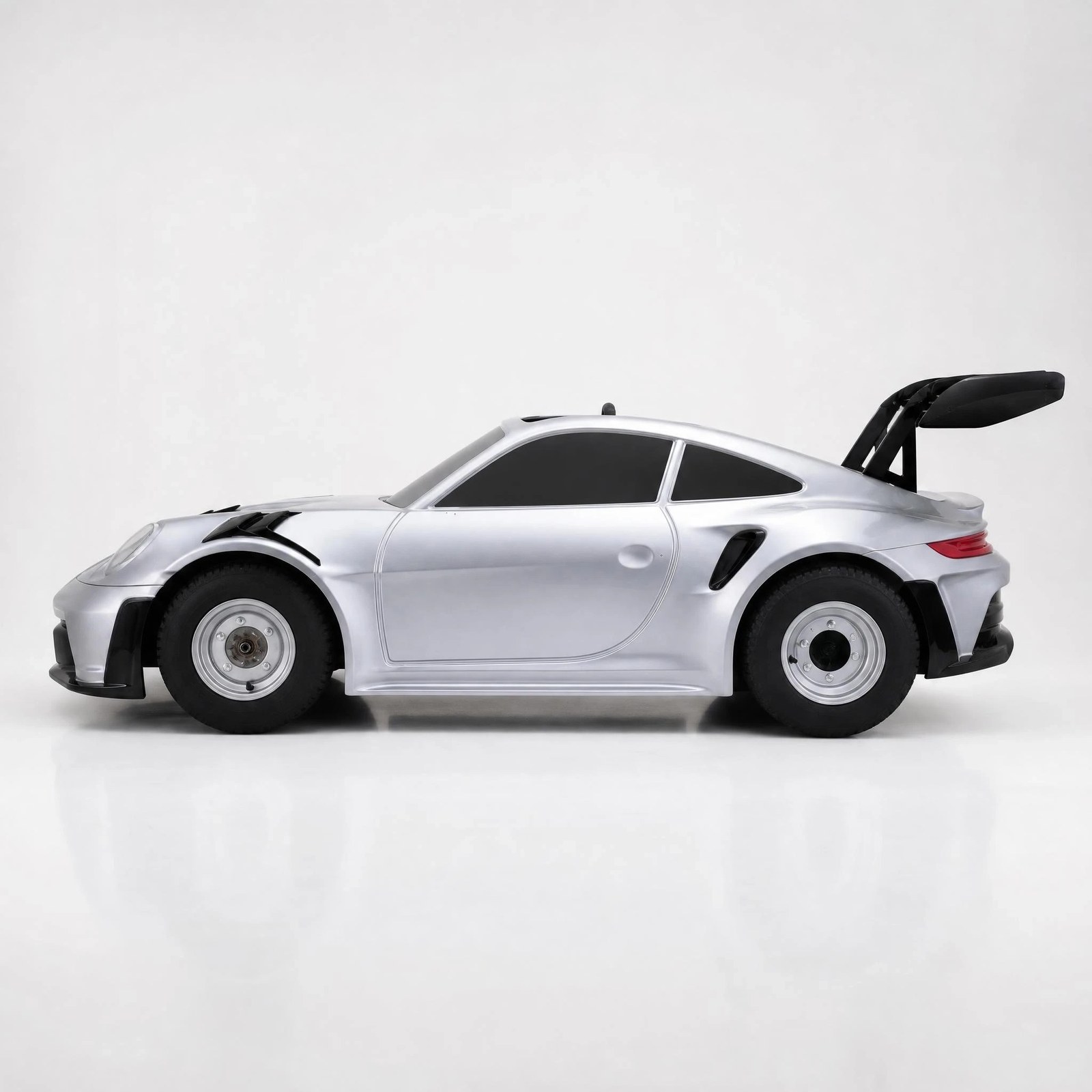
A 964-style electric kart and a GT3-style sprint chassis can both wear the mark legitimately, as the side profile above suggests: guards, covers and labels are what a file describes. Only the paperwork tells you whether the mark covers the exact machine standing in your pit lane, at the speed and load you actually run it at.
The Four Documents a Real File Contains
A complete go-kart certification file contains four things. A supplier selling into rental fleets should be able to send all four without asking a colleague, and if two arrive while the others are “with the factory,” treat the file as incomplete until they land.
EC Declaration of Conformity
One signed page naming the manufacturer, the machine type and model, the directives applied and the standards used. It must match the serial plate riveted to your chassis, not the model family in the brochure. If the stated serial range stops before your fleet numbers, you are holding a declaration for somebody else’s karts.
Technical File
Annex VII of the directive defines its contents: drawings, calculations, the standards applied, the risk assessment and the instructions. You will rarely receive it in full, because manufacturers keep it available for authorities rather than shipping it. What you should receive is a written commitment that the file exists, that it covers your model, and that it can be produced on request within a stated time. That commitment is the part of go-kart certification you can actually hold a supplier to.
Risk Assessment and Guard List
Which moving parts are enclosed, what a rider’s hand or foot can reach, where the pinch points sit, and how each hazard was reduced. Ask for the guard list as a drawing rather than as prose. A rear bumper that appears in the drawing but not on the delivered kart is the quickest way to spot a file copied from a different model.
Test and Inspection Record
Brake performance, steering play, speed limiting and insulation checks, with dates and serial numbers. A record for the prototype proves the design was validated. A record for your serials proves the machine in your hall was built to that design. Buyers ordering a fleet should ask for the second, not the first.
Read the Chassis, Not the Brochure
Documents describe the intent behind a go-kart certification; the kart describes reality. Walk one unit from end to end before you read anything, and check the items below in the order a marshal would meet them during a session change.
- Chain or belt enclosure. Continuous cover, all fasteners present, no gap wide enough for a finger at either end.
- Brake hardware. Lines and rods routed away from the axle and the wheel, with no contact witness marks on the paint.
- Seat mounting. Bolted to the frame, not to bodywork or a decorative tub that flexes under load.
- Serial plate. Riveted, legible, and matching the declaration you were sent. A sticker is not a plate.
- Isolator or emergency stop. Reachable from the driving position, and reachable by a marshal standing beside the kart.
- Edge finish. No sharp returns on panels, no exposed bolt threads at knee or shoulder height.
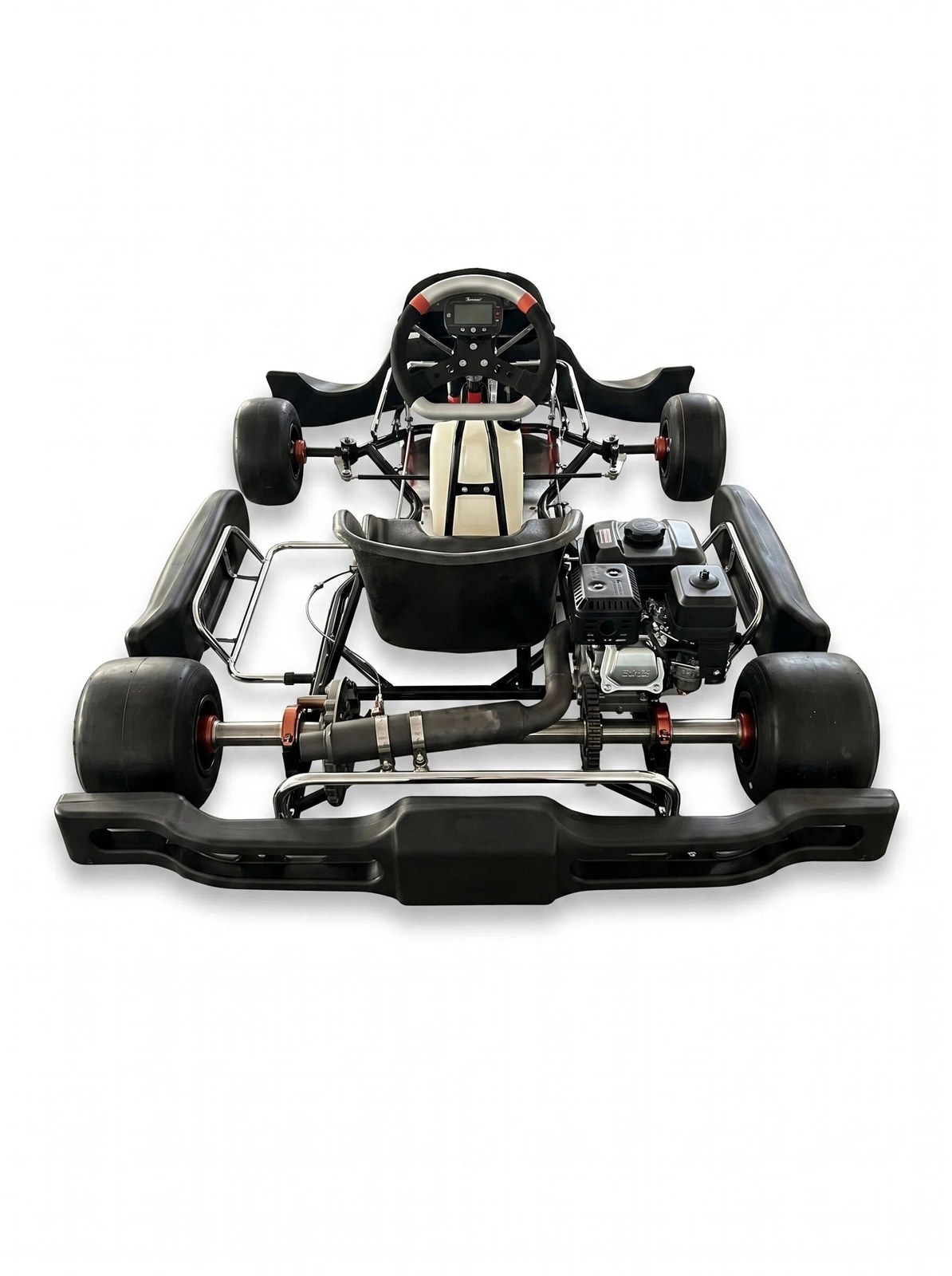
The rear view above is where most walk-arounds pay for themselves. Bumper, chain run, engine bay and axle sit in one line of sight, so a missing fastener or a guard pulled for service and never refitted shows up in seconds. Do it on a kart that has run a full weekend, not on the unit prepped for your visit.
Cross-Check the Specification Against the File
The numbers in the declaration and the numbers on your website have to be the same numbers. Where they differ, the higher figure is usually the marketing one, and it is the figure that will be quoted back to you after an incident. The table below shows the specification lines worth matching one by one. Any go-kart certification worth the paper it is printed on will survive that comparison.
| Model family | Drive | Top speed | Rated load | Line to match in the file |
|---|---|---|---|---|
| 964-style, wide-body, muscle-style replica | 2500 W mid-mounted motor, 72 V 50 Ah | 80 km/h (50 mph) | 300 kg (661 lb) | Rated speed limit and maximum rider mass |
| GT3-style sprint chassis | Electric, 220 kg (485 lb) kerb weight | 60 km/h (37 mph) | 300 kg (661 lb) | Kerb weight and rated speed limit |
| 964-style range figure | 72 V 50 Ah pack | 60 km (37 mi) per charge | 300 kg (661 lb) | Battery configuration and duty cycle tested |
A 2500 W mid-drive motor at 72 V is a sensible rental package: enough torque to slide a rear axle on a wet surface, not enough to frighten a first-timer on a short indoor layout. The 964-style cabriolet and the GT3-style chassis sit at different points on that scale, and each should arrive with its own declaration rather than a shared family document.
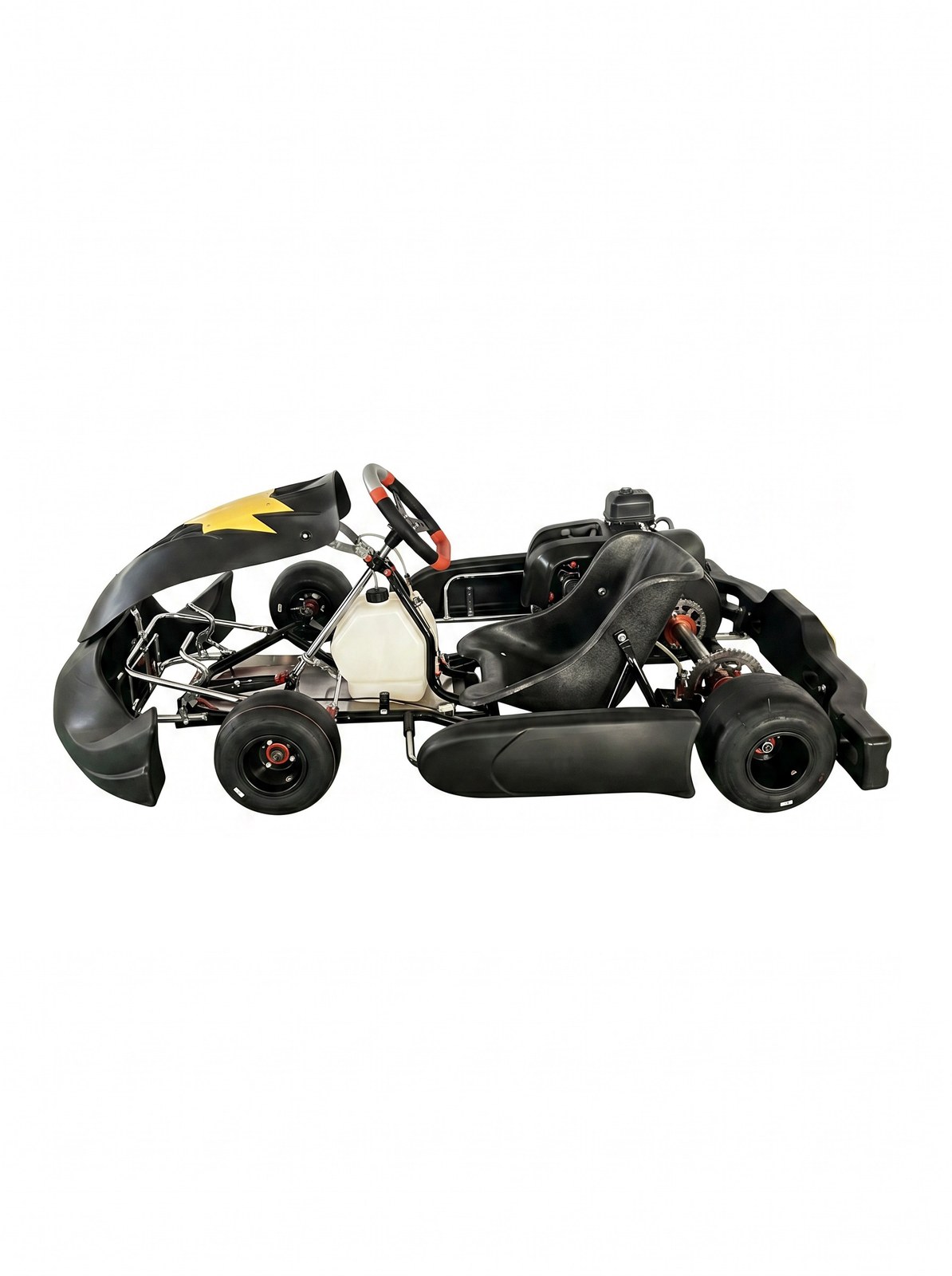
Petrol rental karts make the same point in reverse. On the side view above, engine, chain run, brake disc and fuel tank are visible from one standing position, which is why a walk-around takes minutes. Whatever the drive type, what the file claims is enclosed must be enclosed on the unit in front of you.
What Changes on 20 January 2027
The Machinery Directive is being replaced by Regulation (EU) 2023/1230, which applies from 20 January 2027. Because a regulation is directly applicable rather than transposed into national law, the same text governs every member state from that date, with no local variations to track.
Three practical consequences for a venue buying karts now. The technical file gets stricter about what must be documented. Digital instructions become the normal route, so the file you receive will increasingly be a link and a revision number. And software that affects safety counts as part of the machine, so a firmware change to a speed limiter is a modification, not a setting.
Three Moves Before the Deadline
That last point deserves a line in your maintenance log, because it is where go-kart certification meets daily operations. If a technician raises a kart’s top speed from 60 km/h (37 mph) to 80 km/h (50 mph) in software to satisfy one corporate group, the machine no longer matches the declaration it arrived with. Reverting the setting before the next inspection is the difference between a tidy audit and an awkward conversation.
- Now: ask every supplier for the declaration matching your serials, and file it with the service history.
- Before 2027: ask whether the declaration will be reissued under the regulation, and who pays for it.
- Ongoing: log any change to speed limits, tires or bodywork against the serial number it touched.
Five Questions Worth Asking Before You Order
These five questions sort suppliers faster than any spec sheet, and they are the practical core of go-kart certification. A serious manufacturer answers within a day because the answers already exist in a folder.
- Can you send the declaration of conformity for this exact model and serial range, signed, as a PDF? Not a family document, not a certificate of compliance to a standard, and not a photo of a badge.
- Which standards are listed on page one, and do they cover karts or only the electrical drive? A declaration that quietly covers the motor but not the chassis is a declaration for a component.
- Who signs the risk assessment, and when was it last revised? A revision date older than the product is a document that stopped tracking the product.
- If we change the tires, the speed limit or the bodywork, does the declaration still hold? The answer should be specific about what triggers a reissue.
- Will you reissue the paperwork under Regulation (EU) 2023/1230 before January 2027? Anyone planning to be in the European market after that date already has an answer.
Fleet buyers negotiating volume should put those answers in the contract rather than in an email thread. Our fleet and venue solutions page sets out how a multi-unit order is documented, and the same structure is worth demanding from any supplier you shortlist.
Where the File Fits in Your Buying Decision
Go-kart certification is a filter, not a feature. It will not make a slow kart fast or a fragile chassis durable, and it will not sell a single session. What it does is remove a category of risk you cannot price: the machine that cannot be insured, the container held at the port, the inspection that closes a hall for a week in high season.
Use it the way you use tire wear: ask early, compare answers, and let the supplier who replies in a day move to the front. If you are assembling a first fleet, compare chassis by ceiling height and track width before you compare price, then ask for the documentation pack on the models you shortlist. Our support team will tell you which documents exist for a given model, and which are produced to order.