
Tuesday, 7 p.m. The track is lit, the marshals are on the clock, and the grid is empty. Two walk-ins, four staff, rent due Friday. Most venues answer that with another discount code. The operators who fix it permanently do something else: they sell those same quiet hours to the same 24 people, six times, before the season even starts. That is a karting league, and it is the cheapest recurring revenue a rental track can build.
A league is not a championship for semi-pros. It is a scheduled, scored, repeating product: fixed night, fixed grid, published table, prepaid entry. The customer stops buying a session and starts buying a position in the standings, which is why the price holds and the calendar fills without another ad spend.

Why a Karting League Beats Another Discount Night
A discount buys one visit and teaches the customer to wait for the next coupon. It also cuts the margin on hours you have already paid rent, power, and wages to keep open. A league buys six visits, paid up front, from people who now have a reason to be at your venue on the night you needed them most.
The second effect is harder to buy. A league produces its own content: results, photos, a table that changes every week, a rivalry that customers explain to their friends for you. That is marketing you do not have to write, film, or schedule.
Do the arithmetic on your own numbers before you plan anything else. Twenty-four drivers at your walk-in rate, once a week for six weeks, on a night that currently earns close to nothing, with no staffing beyond the roster you already run. If that total does not move you, the format is wrong, not the idea.
Step 1: Choose the Night Your Grid Can Fill
Pick the weakest staffed night, not the strongest. If you already pay marshals and a host on Tuesday, Tuesday is where a karting league costs you nothing extra to open. Friday and Saturday are the wrong answer even when they look tempting: every league seat there displaces a full-price retail session.
Commit to one slot for the entire karting league season. Six consecutive weeks is long enough to build a table people care about and short enough that a beginner will say yes. Same night, same start time, no rescheduling.
Then invite in the right order. Past customers first, then the walk-in regulars who already lap on that night, then a public post. A league that launches to strangers spends its first season explaining itself instead of scoring races.
Step 2: Cap the Grid at Karts You Can Turn Around
Your grid size is not your fleet size. It is the number of karts you can cycle through a heat, swap, and send out again without a queue forming in the pit lane. Count usable karts on that specific night, subtract two for spares, and subtract anything waiting on parts.
Twelve healthy rentals usually means an eight-kart grid: two spares, two rotating through service. That feels small until you watch a ten-kart grid stall because the ninth kart has a soft brake pedal. A short grid that starts on time every week beats a full grid that starts eleven minutes late.
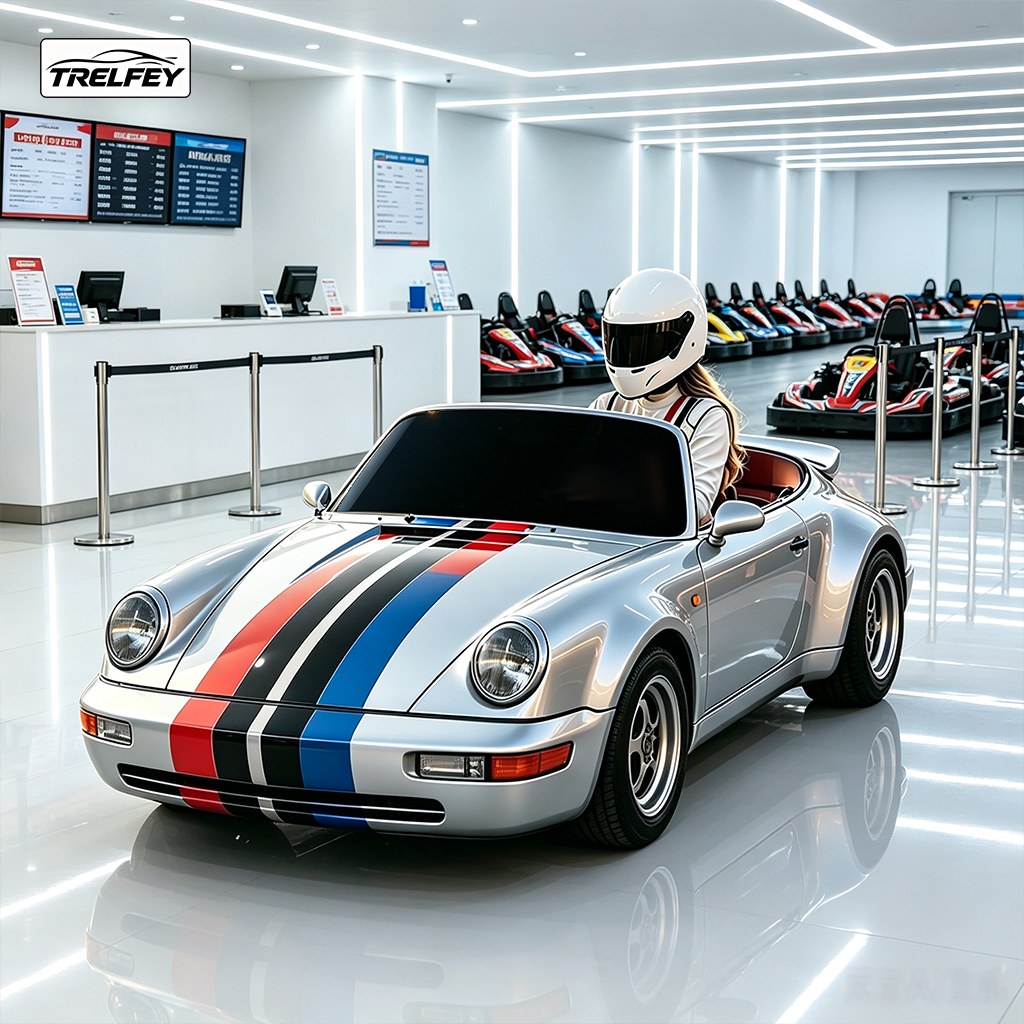
Size the fleet for repeat cycles rather than one impressive lap. Take the 964-style P964 Cabrio rental: a 2500 W mid-drive motor, a 72 V 50 Ah pack, 80 km/h (50 mph) on the straight, 60 km (37 mi) of range, and a 300 kg (661 lb) rated load. Those figures matter on a karting league night because they decide how many rounds you get from one pack, not how fast the kart looks in a photo. If you are comparing shapes and price points instead, the full rental range is organized by use case.
This is also where most operators discover their bottleneck is not karts but battery management. If a round cannot start because two packs are still charging, the night runs late and the table becomes unreliable. Fixed packs, fixed swap order, one person responsible for both.
Step 3: Price the Season, Not the Heat
Sell the karting league season as one purchase. A six-round seat, paid before round one, turns a maybe into a commitment and covers trophies, timing, and the marshal hour before you have earned a cent of it. Per-round pricing invites people to skip the week they are losing on.
Keep the round short and repeatable. Ninety minutes on the clock, everyone drives a comparable number of laps, and the whole event fits inside a staffed block you were paying for anyway.
| Segment | Clock | Grid | Who runs it |
|---|---|---|---|
| Check-in and briefing | 0-10 min | All drivers | Host |
| Practice | 10-16 min | Split A / B | Marshal |
| Qualifying | 16-26 min | Split A / B | Marshal, host on timing |
| Feature race | 26-40 min | Full grid | Marshal |
| Podium and reset | 40-50 min | All drivers | Host |
Before you set the number, list what the seat has to pay for. Most first-season karting leagues are quietly subsidized by the workshop because nobody wrote this down:
- Kart wear. Tyres, brake pads, and the consumables a weekly race night eats faster than walk-in traffic.
- The marshal hour. Priced honestly, not absorbed into the retail roster.
- Timing and the leaderboard screen. Including the person who keeps it accurate.
- A season prize. Something a customer would photograph, not a voucher they forget.
- Admin. Entry list, waivers, and the messages you will send every single week.
Step 4: Publish a Leaderboard Nobody Can Argue With
A karting league dies the week the results feel arbitrary. Write the scoring down before round one and send it to every driver: points by finishing position, one bonus point for fastest lap, worst round dropped at the end. Then do not change it mid-season, no matter who complains.
Weight the Scoring So One Fast Regular Cannot Run Away
Straight finish-order points reward the driver who already owns a helmet. Add a consistency bonus, drop the worst round, or run two classes split by qualifying time so a beginner races someone at their own pace. A league where the same person leads by forty points after round two has no round five.
Post the Table Where Customers Queue
One screen at check-in, updated before the first heat, beats a PDF emailed on Monday. Screens create spectators, and spectators are the people who ask how to join next season. If you want the format to read like a real championship rather than a house game, the FIA Karting regulations cover race procedure in more depth than most rental venues need.
Step 5: Staff the Night With One Marshal and One Host
Two roles, not five. The marshal owns the track: grid order, start lights, flags, and the decision to stop a heat. The host owns everything else: check-in, timing entry, the table, and the queue. Splitting those jobs keeps both people from doing neither.
Train the host on the timing software before the season, not during round one. A dropped lap time in week two costs more trust than a slow kart. If your team needs refresher material or spare parts between rounds, support is the shortest route back to a full grid.
Safety stays boring and repeatable: the same pre-session check every round, the same briefing length, the same barrier walk at the end of the night. Every kart on the grid should also have a CE declaration of conformity to the EU Machinery Directive 2006/42/EC on file, not in a folder nobody can find on a Friday. Industry bodies such as IAAPA publish operational guidance that maps cleanly onto a weekly event, and a written routine is exactly what an inspector asks to see.
Step 6: Turn Race Night Into Next Season’s Bookings
The last round of a karting league is not the end of the product. It is the sales meeting. Run it as a longer night, invite every driver to bring one friend who has never been, and hand out the next season’s dates while people are still holding a trophy.
Three conversions happen in that room. League seats renew, spectators become beginners, and one or two drivers ask whether the venue can host their company night. Have the answer ready, because a commercial track solution conversation is far easier when the fleet has already proven itself under league load.
Close the season with the same discipline you opened it. Publish final standings, photograph the podium, and send each driver a one-page summary of their own season: rounds raced, best lap, positions gained. That page is the cheapest renewal tool you will ever build.
The venue math is simple. A karting league does not need a bigger building, a new attraction, or a marketing budget. It needs a night you already staffed, a grid you can actually turn around, and a table that people trust enough to argue about.