
A kart leaving a 480-metre circuit at 40 km/h is travelling 11 metres a second, and it will stop in whatever distance you gave it. Put 0.6 metres of padding between the kart and a steel post and the driver absorbs roughly 10 g. Give the same kart 1.2 metres of give and that falls to about 5 g. Karting track barriers are the one part of the layout that decides how many g a paying guest feels on a bad lap.
Most karting track barriers get bought for the places the owner walks guests through: the first corner, the pit lane, the photo spot. The corner that produces incident reports is usually the outside of the fastest turn or the wall at the end of the longest straight, where karts arrive two abreast and a novice is still on the throttle. That is a zoning problem before it is a purchasing problem.
What Karting Track Barriers Actually Have to Do
Three jobs, in this order. Contain the kart so it cannot reach spectators, posts or the drop behind the wall. Convert speed into deformation rather than into the driver’s spine. And redirect the kart along the barrier instead of stopping it dead, because a dead stop at a 30-degree impact angle is how frames bend and wrists break.
The third job is the one that gets under-designed. A tyre wall that swallows a kart and spits it back onto the racing line is worse than a steel rail that lets it slide fifteen metres down the outside. Angle matters as much as material.
Two documents are worth reading before you approve a layout. ASTM F2007-24 sets out practice for the design, manufacture and operation of concession go-karts and their associated operating facilities, and your supplier should be able to talk through it. In the UK, HSE’s HSG175 guidance on fairgrounds and amusement parks sets out what operators, designers and suppliers are expected to do to reduce risk, and it is the document to cite in the risk assessment for the edge of your circuit.
Neither document gives you a specification for one corner. That number comes from the speed your fastest kart carries in and the run-off you will give away.
Soft Padding, Steel and Tyre Walls: What Each One Is For
Every karting track barrier is a compromise between energy absorption, redirect angle, repair cost and floor space. Treat the table as a zoning tool, not a shopping list: a circuit built from one material is either over-built in the pit lane or under-built at the fastest corner.
| Barrier type | Where it belongs | What it does to a kart | How it fails | Cost profile |
|---|---|---|---|---|
| Foam pad on steel backing, 50–100 mm | Pit lane, low-speed corners, walkway edges | Scrubs 10–20 km/h with almost no rebound | Seam splits, foam hardens in UV and starts transmitting the post behind it | Cheap to replace, most often neglected |
| Bolted tyre wall, two rows | Corner exits, drift zones, outdoor circuits | Absorbs heavy hits, very little bounce back | Tyres ride up the stack and a nose digs underneath | Labour-heavy to install, near-zero to repair |
| Steel armco or guardrail | Long straights, walls the kart runs parallel to | Redirects at shallow angles, keeps the kart moving | Unforgiving at 90 degrees, absorbs almost nothing | Long service life, highest injury cost per hit |
| Inflatable or air-filled barrier | Indoor halls, tight hairpins, temporary layouts | Progressive deceleration over a long stroke | Puncture, slow pressure loss, a soft barrier by Friday | Highest capital cost, needs a weekly pressure log |
| Earth berm with grass run-off | Outside of fast outdoor sweepers | Highest energy capacity on site | Ruts, mud, drainage that stops working in year two | Cheap to build, expensive to maintain |
Height is the second decision, and it is where most of them get specified by eye. Below roughly 500 mm a kart nose can climb the barrier and the frame goes over the top; much above 800 mm and you buy sightline problems for every marshal on the circuit.
These are rules of thumb from track builds, not certified test results. Your engineer and insurer sign off the layout, and both want the reasoning, not the purchase order.
How to Zone Karting Track Barriers by Impact Speed
Split your karting track barriers into three zones and spend in that order. Most venues that get hurt have spent evenly across all three.
Zone one: the end of the longest straight. Your fastest kart arrives here at maximum speed, often with a novice who braked one marker late. The barrier needs depth in front of it, not just strength: two to three metres of deformable run-off, a padded or air-filled face, and nothing rigid within the first metre of travel. If the site hands you tarmac right up to a wall, shorten the straight or add a chicane. Do not solve it with thicker foam on the same wall.
Zone two: corner exits and drift sections. Karts leave these sideways at lower speed and a shallow angle, which is the case a tyre wall handles well. Two rows bolted together, the top row staggered back so the face leans into the impact, and nothing that can hook a stub axle. This is also where electric drift karts load a barrier hardest: the layout is designed to arrive at the wall at an angle and use it.
Zone three: pit lane, walkways and the pedestrian edge. Speeds here are under 15 km/h, which makes operators relax, and this is where staff and bystanders get hurt. Padding at hip height, no exposed steel edge, no gap a shoe can enter, and a physical stop that keeps a kart from rolling into the queue when a driver forgets the brake. A pit lane barrier is a furniture problem as much as a crash problem.
One constraint runs through all three: whatever you build must leave the marshal’s sightline intact and a route for a responder on foot. A barrier that protects the spectator and blocks the path to an inverted kart has moved the risk, not removed it.

Three Barrier Mistakes That Show Up in the Incident Report
Padding bolted to the thing it is supposed to protect. A hundred millimetres of foam on a 100×100 mm steel post means the post is the barrier after the first hundred millimetres of travel. The pad becomes a cosmetic layer that delays impact by two hundredths of a second and hides the hazard from whoever inspects the circuit next. Either put the post behind a deformable layer deep enough to matter, or move it out of the impact line.
Budgeting the corners you can see from the office. Owners walk the circuit from the entrance, so the first corner gets the new padding and the back straight keeps whatever barriers came with the site. Walk it the other way, at the speed a kart actually travels, and start at the fastest point: end of straight, outside of the fastest turn, pit lane, everything else.
Treating barriers as capital rather than consumable. Foam hardens, tyres crack, bolts disappear, and an air barrier loses pressure silently overnight. A twenty-minute monthly walk with a torque wrench, a knife and a camera log is the difference between karting track barriers that work in year four and ones that only look like they do. Regulators are moving the same way: the Safe Work Australia guide for amusement devices now sits alongside model work health and safety amendments that add explicit record-keeping and operator training duties. An undated barrier is an undocumented one.
Matching the Barrier Plan to the Karts You Buy
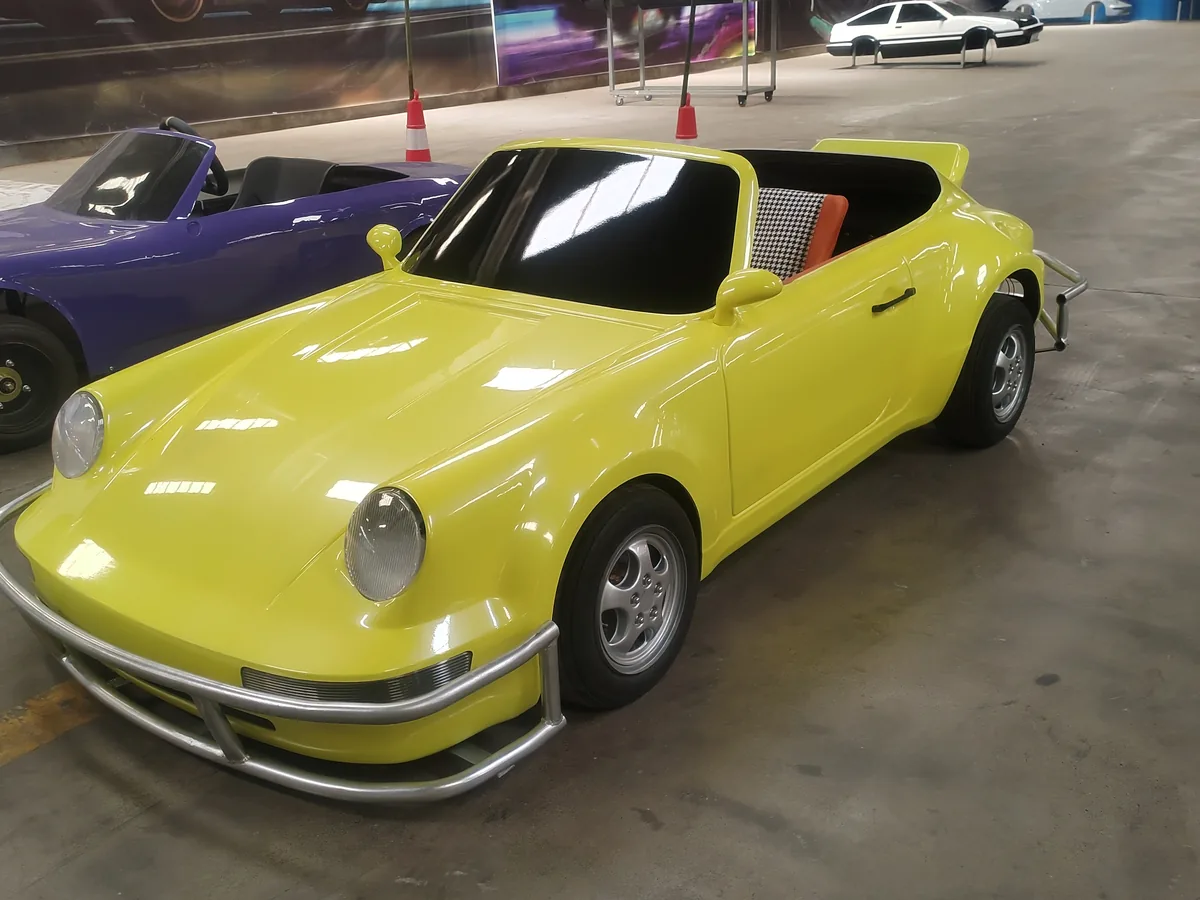
Depth follows the fleet, not the branding. A 225cc four-stroke such as the ZS225-V carries more speed into a braking zone than a drift kart, so the run-off at the end of your longest straight is set by the quickest thing you own — buy the karts first, then size your karting track barriers to them. A low-speed drift platform like the Hellcat shifts the budget the other way: less run-off at the end of the straight, more tyre wall and pad at the exits where guests spend the session sideways.
The fleet size that sets how much run-off you need is in how many go-karts a rental track needs, and recent build notes on karting track barriers and run-off detail sit in the insights archive.
FAQ
How thick should go-kart track padding be?
For pit lane and low-speed edges, 50–100 mm of closed-cell foam on a continuous backing takes the sting out of a walking-pace contact. For anything a kart reaches at speed, thickness alone is not the answer: doubling foam changes deceleration far less than adding a metre of travel.
Is a tyre wall cheaper than a steel barrier?
Cheaper to repair, more expensive to build. A bolted two-row tyre wall takes labour and a lot of tyres to assemble, then costs almost nothing per hit because you re-stack it. Steel goes up quickly and lasts a decade, but every hard contact is a chassis repair. On a rental circuit full of novices, the tyre wall usually wins on total cost by year three.
Do I need barriers on both sides of the track?
Only where a kart can leave the surface with speed — which is more of the circuit than most first layouts assume. The inside of a corner rarely needs one; the outside of every corner, both ends of the straight and the whole pit lane do. Grass run-off counts as a barrier only while it is dry, mown and free of posts.
Can I use inflatable barriers indoors?
Yes — the best answer for a tight indoor hairpin with a concrete column behind it. Two conditions: a weekly pressure log with a named person, and a spare section on site. An inflatable that has leaked for three weeks behaves like a heavy bag of air and nothing else.
What will my insurer ask about the barriers?
Usually three things: a layout drawing with barrier types marked by zone, the reasoning that connects each zone to the speed karts carry, and a maintenance record. Dated photographs beat a supplier certificate because they show the barrier as it is today.
Send us your circuit drawing, your fleet mix and your fastest corner speed, and we will come back with a zone-by-zone barrier plan plus the kart configuration that fits it — request a quote.