

Most venue owners describe their track layout in lap times and corner names. The number that pays the rent is less romantic: how many paying drivers you cycle through each hour, per square meter of floor you already lease. A layout that feels quick on a Saturday can quietly under-earn all week, and the fix is usually geometry rather than ad spend.
What follows is the routine we run with rental operators before they order karts or commit to a second site. One afternoon, a laser measure, a spreadsheet — no design software required.
Why Track Layout Beats Marketing on the Balance Sheet
Indoor karting carries three costs that ignore your traffic: rent, staff and the fleet itself. Power, tires and brake pads scale with use, but they scale slowly. The lever you can move every weekend is how many paid sessions fit inside the floor you already have.
Two venues on the same 2,000 m² (21,500 sq ft) can finish the year 40% apart with identical karts and identical pricing. The gap sits in lane width, corner count, and where the karts wait between sessions.
Marketing fills a session. Geometry decides whether that session had room to exist in the first place.
Four Measurements That Define a Workable Track Layout
Walk the floor with a laser measure and record each number at the worst point on the circuit, not the best. These four decide how much of the hour you actually sell.
Lane width
A rental kart needs room to be driven badly. Below 4 m (13 ft) between barriers, a nervous novice spends the lap lifting off, and the session turns into a slow queue with steering wheels attached.
Two-seaters need more room than the spec sheet suggests. A 964-style cabrio carrying an adult and a child is a wider, heavier object than a single-seat sprint chassis, and drivers misjudge that width for the first two laps every time.
Corner radius
Ninety-degree corners with a 3 m (10 ft) radius suit rental traffic: slow enough to discourage contact, fast enough that the driver has to do something. Tighten below 2.5 m (8 ft) and your marshals spend the evening restarting karts instead of watching lines.
Run-off depth
Every corner needs somewhere for a mistake to finish. We specify two kart lengths of clear run-off before the barrier. Without it, drivers brake 10 m (33 ft) early, lap times scatter across the session, and your rotation count falls with them.
Staging depth
A staging lane that holds one full session is worth more than 30 m (98 ft) of extra track. When karts rejoin from the side of the circuit, the marshal has to stop the session twice per rotation. When the lane holds all ten, the rotation never breaks.
The Overhead Number That Caps Your Sessions Per Hour
Session length is set by fixed overhead, not by the lap count painted on your price board. Check-in, briefing, belting, debrief and moving karts in and out usually cost between 6 and 12 minutes. Green-flag time rarely stretches past 7 min 30 s — about 10 laps at 45 s.
Run the arithmetic and something uncomfortable appears. Shortening the circuit barely changes throughput, because green-flag time is the smaller half of the cycle. Cutting turnaround is what moves the number.
| Turnaround overhead | Rotations per hour | Drivers per hour, 10 karts | Drivers per hour, 14 karts |
|---|---|---|---|
| 12 min | 3.1 | 31 | 43 |
| 10 min | 3.4 | 34 | 48 |
| 8 min | 3.9 | 39 | 54 |
| 6 min | 4.4 | 44 | 62 |
Assumes 7 min 30 s of green-flag time per rotation and every seat sold. Your own briefing and belting times will shift the rows, not the shape of them.
Dropping from 12 minutes of overhead to 8 buys eight more drivers an hour on a 10-kart fleet — a quarter more revenue from the same floor, the same staff and the same karts.
That is the argument for a staging lane, a second briefing screen and a kart park near the exit. All three are track layout decisions wearing an operations costume.
Revenue Per Square Meter, Worked Through
Multiply drivers per hour by your ticket, then divide by the floor you actually pay for — circuit, pit, reception and seating included. That single figure is the only honest way to compare two sites, or two versions of the same plan.
Take a 900 m² (9,700 sq ft) hall with 10 karts, 8 minutes of overhead and a $22 walk-up ticket. A 7 min 30 s session yields about 3.9 rotations an hour: 39 drivers, roughly $858 an hour at full utilisation, or $0.95 per square meter per hour.
Keep the hall, add four karts. Fifty-four drivers, about $1,188 an hour, $1.32 per square meter. The rent did not move an inch. That difference is what a track layout is worth in cash.
Full utilisation is a Saturday condition, not a weekly average. Model weekdays at 25–35% of peak before you believe any projection, and treat the peak figure as capacity rather than income.
Where Karts Sit When They Are Not Racing
Storage is the part of the plan drawn last and paid for first. Fourteen karts parked nose-out eat roughly 40% more floor than the same fleet nested nose-to-tail in alternating rows, flipping which end faces the aisle.
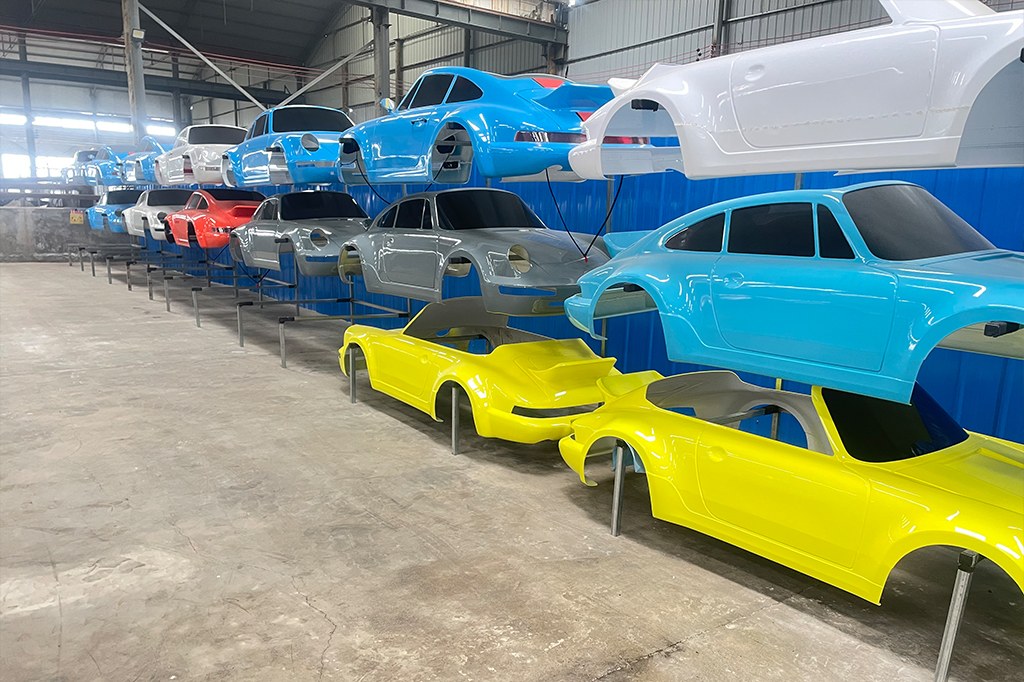
Count the real footprint: kart length plus 0.6 m (24 in) of walking space, then add the charging bay. A fleet that charges where it parks needs no separate bay at all, which is one of the quieter reasons operators move to electric.
Keep one kart-width clear behind the charging row and route cables away from the driving line. It is the cheapest safety decision in the building and the first thing an inspector photographs.
Mixing Speeds Without Wrecking the Session
A 2500 W mid-drive kart on a 72 V 50 Ah pack runs 80 km/h (50 mph) with 60 km (37 mi) of range and a 300 kg (661 lb) load rating. A GT3-style sprint chassis tops out at 60 km/h (37 mph) at 220 kg (485 lb) kerb, and carries the same 300 kg (661 lb).
Put both on one green flag and the quick drivers arrive at the hairpin while the slow ones are still turning in. Either split sessions by chassis class, or govern the faster karts for mixed groups.
Two-seaters earn differently rather than faster. A parent and child pay for one seat and fill two helmets, and they convert the walk-up family traffic a single-seater cannot serve at all — the 964-style cabrio page shows the seating geometry you are planning around.
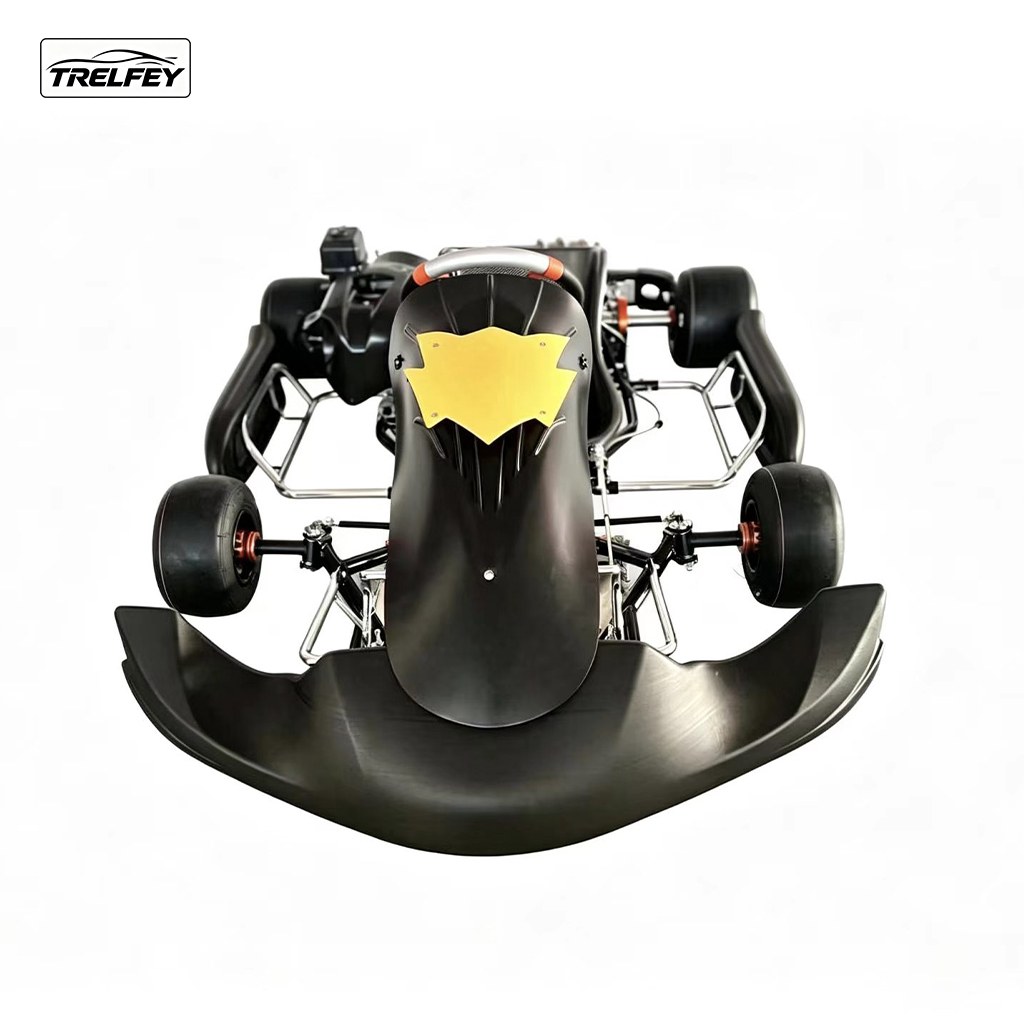
On a small floor, the GT3-style car is often the better first purchase: shorter, 220 kg (485 lb), and easier to recover from a barrier kiss. The GT3-style chassis carries the dimensions you need for a first sketch.
Five Track Layout Mistakes That Cost You Sessions
- Measuring the widest point. Your circuit is only as wide as its narrowest barrier gap, and that gap sets the pace for the whole lap.
- Rejoining mid-straight. Karts entering from the side force a session stop. Enter from a lane, or budget for two stops per rotation.
- One corner that needs explaining. If a marshal coaches it at every briefing, it is costing you green-flag time twice.
- Forgetting the queue. A reception that holds 20 people comfortably protects your check-in overhead; a cramped one adds minutes you never bill.
- Drawing before buying. Choose karts first, then draw around their real length, width and turning circle. The reverse order always produces one compromise corner.
What to Ask Before You Draw the Line
Ask for dimensional drawings before anyone opens CAD: overall length, track width, turning circle, seat height and charging voltage. Our fleet planning notes cover the sizing maths for a first sketch, and every model page lists the numbers behind it.
Ask which parts ship as consumables — tires, pads, bearings — and how long a swap takes with one mechanic on shift. Under the EU Machinery Directive the technical file and risk assessment should travel with the machine; the directive text sits on EUR-Lex, and the Commission’s machinery pages track the move to the incoming regulation.
For operating benchmarks beyond your own floor, industry bodies such as IAAPA publish material worth reading before you size a party room or a family zone.
If the floor is awkward — a pillar, a ramp, a narrow neck between two units — send the plan to support before you order. Bodywork and gearing decisions are far cheaper to agree before the build than after it.
A track layout is not a design exercise. It is your hourly capacity in physical form, and it is much cheaper to correct on paper than in concrete.