
Twelve karts on a 480-metre circuit with one marshal standing in the middle is a staffing plan that looks fine on a whiteboard and fails at one specific corner: the far one, where two karts arrive together while the marshal is watching the near side. Karting track staffing is arithmetic, not instinct, and the number you staff to is the count of karts moving at the same moment — never the count you own.
A 20-kart fleet that runs 10 at a time needs the crew for 10. A 12-kart fleet on a tight indoor circuit can need almost the same crew, because indoor sightlines break at every pillar and every blind exit. Settle the simultaneous count first — session length and turnaround time decide it — then let the karting track staffing plan fall out of that number instead of out of the invoice.
The Karting Track Staffing Ratio: One Marshal per Six Karts in Motion
One marshal can hold six karts in view and still have a hand free to wave a yellow. That is the practical ceiling on an outdoor circuit with clean sightlines and roughly 40 metres between flag stations. Above six, you are asking one person to watch two groups arrive at the same braking point, and the second group is the one that gets missed.
Indoor circuits bend the number in both directions. A short 200-metre layout with a mezzanine view lets one marshal cover eight or nine karts, because the whole loop sits inside one field of view. A pillar-heavy hall with a blind hairpin behind the arcade wall drops the ratio to five, and no amount of radio discipline fixes a corner nobody can see.
The table below is the default we would defend in front of an insurer: 8-minute sessions, a 2-minute turnaround, one group on circuit, and every corner visible from a marshal position.
| Karts in motion | Circuit marshals | Grid / pit hands | Front desk | Duty manager | Bodies on shift |
|---|---|---|---|---|---|
| 6 | 1 | 1 | 1 | Covered by grid hand | 3 |
| 10 | 2 | 1 | 1 | 1 | 5 |
| 14 | 3 | 2 | 1 | 1 | 7 |
| 20 | 4 | 2 | 2 | 1 | 9 |
Read the last column as people physically present, not people on the payroll. The gap between those two numbers is where new venues lose their safety margin.
Where the Fourth Body Actually Goes
New operators tend to assume the extra person is a second marshal. Usually it is not. At 10 karts in motion, the bottleneck is the pit lane: six-point belts, seat inserts, a height check and a briefing, all inside 120 seconds, for ten people who have never sat in the kart before.
The grid hand owns that 120 seconds. Their job is to have the next group belted and briefed before the previous group’s karts have stopped moving, which means they work on the incoming group while the outgoing group is still on circuit. If the same person is also expected to relieve a marshal, the grid slips, the queue grows, and the pressure to shorten the briefing arrives exactly when it should not. That double duty is the single line most karting track staffing budgets get wrong.
The front desk is the other post that must never be doubled up. It is the only position that can stop a session for someone who has walked in off the street, and it is where the waiver, the height check and the payment live. Pull that person onto the grid during a rush and you have a venue running karts with no one watching the door.
Cover Factor: Three Marshal Seats Is Five People
Positions are not people, and this is where most karting track staffing budgets break. Take three marshal seats on a circuit open six days a week, ten hours a day. That is 60 trading hours per seat, 180 marshal-hours per week before anyone takes a break. A full-time contract of 40 hours covers 40 of them, so each seat needs 1.5 people, and the 60-hour week still has to absorb holidays, sickness and the fifteen minutes when a marshal cannot leave post.
Add a realistic 15 per cent for absence and breaks and the multiplier lands at about 1.7. Three seats become five people on the contract, and the fifth is not padding — it is the relief that lets a marshal step off the circuit at hour seven without closing a lane.
Where you operate in the EU, shift length is not purely a commercial decision. Directive 2003/88/EC on the organisation of working time caps average weekly hours at 48 including overtime unless the individual opt-out applies, requires 11 consecutive hours of daily rest, and requires a rest break once the working day exceeds six hours. A ten-hour single shift therefore needs a break structure built in, and a break structure needs a body who is not on the circuit.
The UK and Ireland follow the same shape through domestic working time rules, and most other markets have an equivalent. Whatever the local number, the arithmetic is the same: seats × trading hours ÷ contracted hours × 1.15, then round up. If the answer surprises you, the roster was already short.
Three Staffing Mistakes That Only Show Up in the Incident Log
Rostering to the fleet instead of the grid. A venue with 24 karts and 12 on circuit writes a rota for 24 karts, decides it cannot afford it, and cuts a marshal. Nothing changes for six months because the cut corner is only exposed when two groups bunch up, and bunching is random. The fix is to write the rota against the simultaneous count and treat the fleet as a spare-parts question.
Using the grid hand as the relief marshal. It works on a Tuesday. On a Saturday it means the pit lane is unsupervised while twenty people in helmets wait for a belt check, and the failure mode is a kart leaving with a lap belt unlatched. Relief has to come from a dedicated floater or from the duty manager, never from the post that touches every guest. Budget the floater inside the karting track staffing figure from day one: it costs less than the incident report.
Training once, at opening. Seasonal staff learn the job from the previous seasonal staff, and within two summers the flag signals have drifted and nobody remembers why the hairpin needs a standing yellow. Regulators increasingly treat that drift as a record-keeping problem rather than a training problem: Australia’s model work health and safety amendments now include explicit operator training and record-keeping duties for amusement devices, as set out in the Safe Work Australia guide for amusement devices. The practical answer is a signed competency sheet per staff member, re-checked every season, plus one logged observation per month.
Industry bodies treat the same ground from the operations side. IAAPA’s safety resources map operator training onto the ASTM, EN 13814 and ISO frameworks, which is useful when a supplier or an insurer asks which standard your briefing script follows. You do not need to adopt all three. You do need to be able to name the one you use.

The Roster Changes With the Drivetrain You Buy
Petrol and electric karts need different hands, not just different numbers. A petrol fleet puts a refuelling and oil-check cycle into every turnaround, which means the pit hand is tied to the kart rather than to the guest: the ZS225-V 225cc four-stroke is a simple engine to service, but it still wants fuel, a warm-up and an exhaust check between blocks, so budget one pit hand per six to eight karts. An electric fleet moves the labour to the charger, where a swap and a logged state-of-charge takes less time but must happen on schedule: the GT3 RS runs 72 V 50 Ah with fast charging as an option, and one hand can cover ten karts provided the charging rotation is written down and enforced.
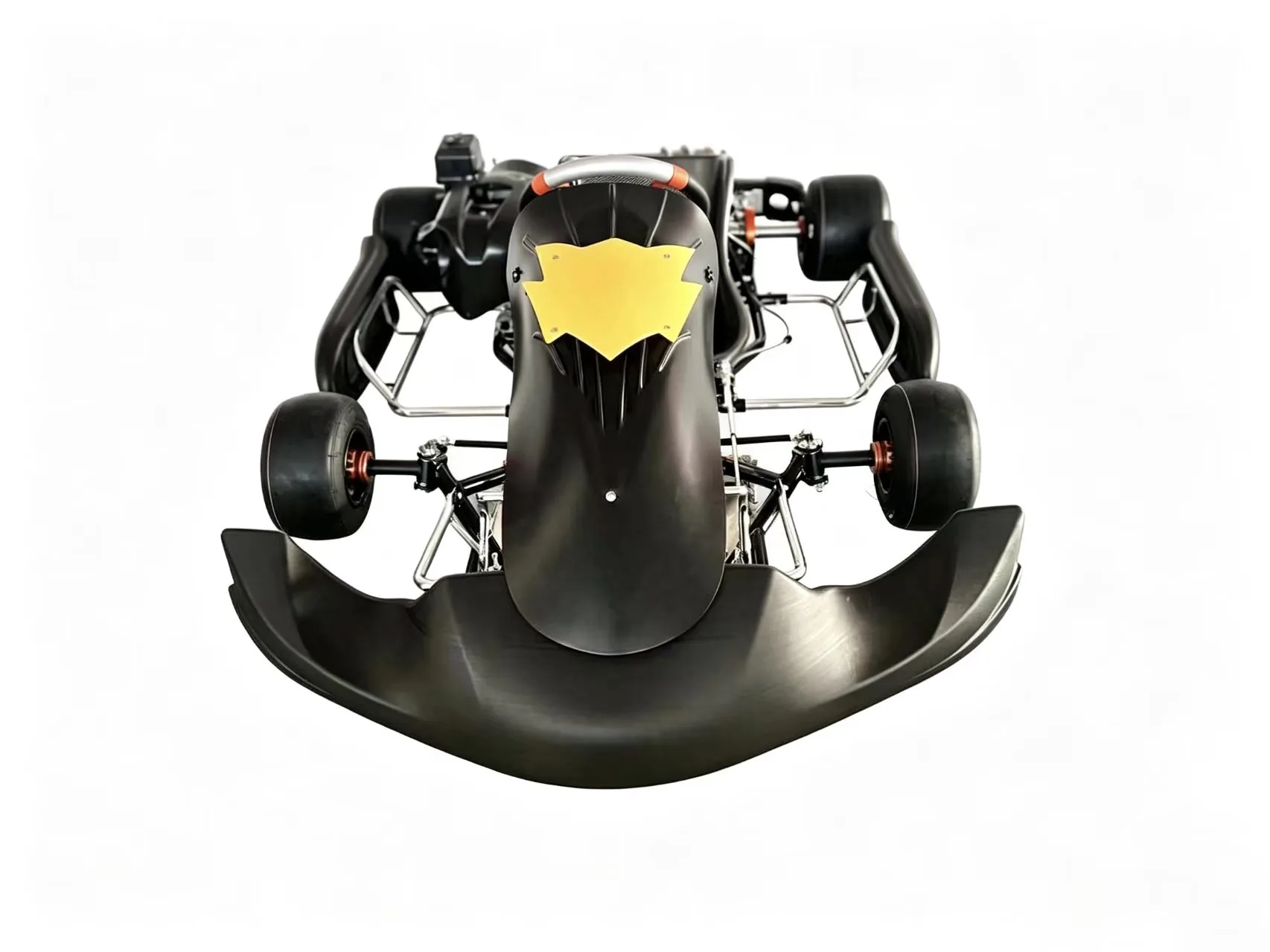
Both decisions land in the same spreadsheet as your session length. If you are still setting the 8-minute block and the 2-minute turnaround, the sequence is laid out in where your karting turnaround time actually goes, and the fleet size that feeds the grid is in how many go-karts a rental track needs.
FAQ
How many staff does a 10-kart track need per shift?
Five bodies on site: two circuit marshals, one grid hand, one front desk and one duty manager. On a short indoor loop with full visibility you can run four by folding the duty manager into the grid, but you lose the person who can shut the session down without abandoning a post.
Can one marshal watch 12 karts?
On a single visible loop, briefly, and not for a full trading day. Twelve karts in one group will string out over the circuit, and the marshal’s attention ends up on the lead kart while the last two arrive at a corner together. Split the group or add a second flag station.
Do I need a dedicated person on the pit lane?
Yes above eight karts in motion. Belts, seat inserts, height checks and briefings take longer than the karts take to come in, and a pit hand who is also the relief marshal will eventually leave the lane unattended during a rush.
Does every shift need a first-aider?
Ask your regulator and your insurer in writing before you open, and put the answer in the shift handover sheet. What you will be asked for is a named person on each shift, a current certificate, and a documented route to emergency services — not a general statement that staff are trained.
How do I cut staffing cost without cutting the ratio?
Shorten the trading window before you thin the grid, and move the quiet hours to a single-marshal booking slot with karts capped at six. A venue open eleven hours with two marshals all day usually spends more than one open nine hours with three at peak, and the second version has a safety margin left at 18:00.
Send us your circuit layout, the number of karts you plan to run at once, and your session and turnaround times, and we will come back with a shift roster template and the fleet configuration that fits it — request a quote.